
FIELD NOTES / Percentages
Reverse percentages: recover the original amount
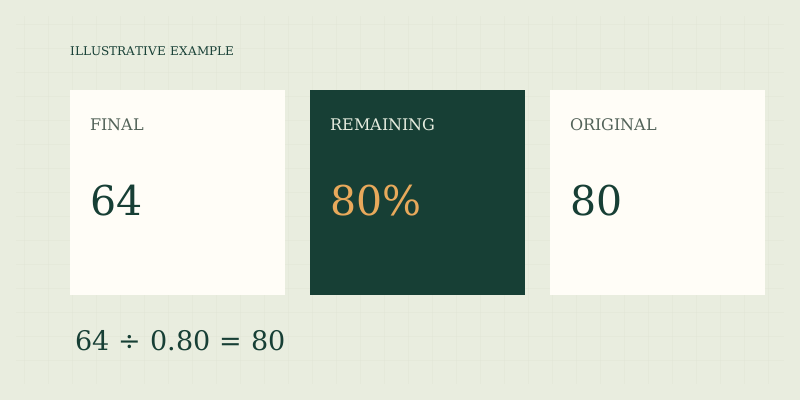
To recover an original amount, divide the known final amount by the multiplier that produced it. After a 20% reduction, 80% of the original remains, so divide by 0.80. After a 20% increase, divide by 1.20. Adding or subtracting the same percentage from the final amount uses the wrong base.
Translate the wording into a multiplier
For an increase of p percent, the multiplier is 1 + p ÷ 100. For a reduction of p percent, it is 1 − p ÷ 100. The equation is final = original × multiplier. Divide both sides by a nonzero multiplier to isolate the original.
| Illustrative statement | Multiplier | Reverse calculation |
|---|---|---|
| $64 after 20% off | 0.80 | 64 ÷ 0.80 = $80 |
| $120 after a 20% rise | 1.20 | 120 ÷ 1.20 = $100 |
| 45 items after a 10% decline | 0.90 | 45 ÷ 0.90 = 50 items |
These are illustrative amounts and quantities. The same algebra works across units, but it does not establish whether a real receipt or report used a single percentage operation.
Check the forward direction
A useful safeguard is to run the recovered original forward. With $64 after 20% off, the recovered $80 gives $80 × 0.80 = $64. If you instead add 20% to $64, the result is $76.80. Discounting that by 20% gives $61.44, so it fails the original relationship. This forward check is more reliable than a remembered rule without context. Write down what the percentage applies to. A “20% markup on cost” and a “20% margin on sale price” have different reference amounts. The words surrounding the percentage determine the multiplier, not the numerical rate alone.
Reverse several successive changes
If an illustrative starting amount undergoes a 20% reduction and then a 10% reduction, the total multiplier is 0.80 × 0.90 = 0.72. A final value of $72 therefore corresponds to $72 ÷ 0.72 = $100. Do not divide by 0.70, because the discounts were not added into a single 30% discount. The order of pure percentage multipliers does not change their product. However, fixed-dollar charges, caps, eligibility conditions, and intermediate rounding can make a real transaction order-dependent. If those elements are present, reconstruct the operations in their actual sequence and reverse them in the opposite order rather than treating everything as one simple percentage.
Remove a known fixed charge first
Suppose an illustrative final total is $75, made from a base amount increased by 10% plus a separate $9 fixed charge. The equation is 75 = original × 1.10 + 9. First subtract the fixed charge: 75 − 9 = 66. Then divide: 66 ÷ 1.10 = 60. The base was $60 under those assumptions. If the fixed charge was included before the percentage, the equation would instead be 75 = (original + 9) × 1.10. That produces a different original. A calculator cannot infer the intended ordering from the final total. Use the bill, agreement, or specification that defines the operations. For taxes and financial agreements, consult the relevant official rules or professional when necessary.
Recognize when no unique original exists
A 100% reduction has a multiplier of zero. Every original amount becomes zero, so the original cannot be uniquely recovered from the final zero alone. Division by that multiplier is undefined. Similarly, a rounded final value can correspond to a range of unrounded originals rather than one exact amount. If the percentage is unknown as well as the original, one final amount does not provide enough information. You need another independent fact, such as the original-to-final difference, a known rate, or an additional equation. Do not substitute a plausible discount and present the result as an established original price.
A reverse-calculation worksheet
- Record the final amount and whether it is rounded.
- Identify every percentage and the base to which it applies.
- Separate fixed charges from percentage changes.
- Write the forward equation before rearranging it.
- Divide by the combined nonzero multiplier only when the operations permit it.
- Reapply the forward operations to verify the answer.
The percentage calculator can verify the forward percentage and discount steps. This version does not include a dedicated reverse mode. Read percentage basics for input conventions, discounts for stacked reductions, and rounding for uncertainty introduced by displayed totals.
Retain the forward equation
Keep the equation with the recovered amount so another reader can see which base, charge order, and multiplier you assumed.
FAQ
Why is the recovery percentage different?
The recovery acts on a changed amount. A fall from 100 to 80 removes 20% of 100. Returning from 80 to 100 adds 20 ÷ 80 = 25% of the smaller base.
Can the original be recovered exactly from cents?
Not necessarily. A rounded final monetary amount may conceal fractions of a cent. Use the transaction's actual rounding rule and treat a reverse result as approximate when the input was rounded.
Can I use this to infer a real tax rate?
Not reliably from a total alone. Different taxable components, fees, exemptions, and rounding can produce the same final amount. Use the actual receipt and applicable authority rather than an inferred rate.
Sources
- Sources and methods — arithmetic assumptions; no current prices or tax rules are supplied.
- Bureau of Labor Statistics: calculating percent changes — original-base convention for checking the forward change.
Put the method to work.
Open calculator ↗