
FIELD NOTES / 02
Dates & days
Count the days. Know exactly which ones you counted.
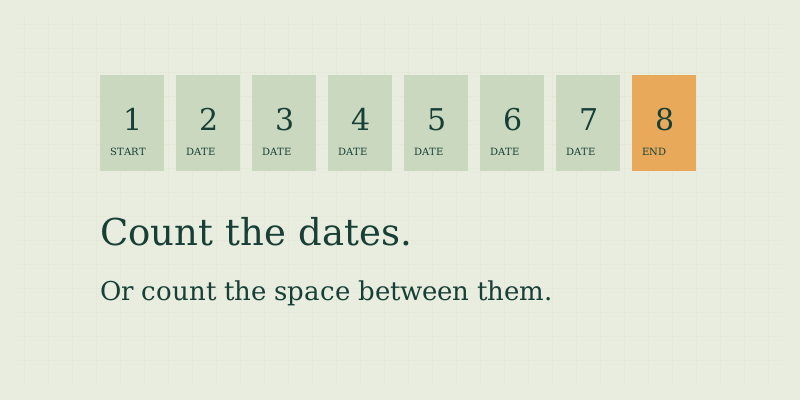
Make the counting convention visible
Date questions often look simple until two tools disagree by one day. These guides help you decide whether the task counts elapsed days, every date including both endpoints, or Monday–Friday dates. The calculator implements those choices explicitly and displays the selected convention with the result. Start with counting basics, then use inclusive days for endpoint examples. Add or subtract days covers signed offsets and day zero. Leap years explains the Gregorian century exception. Months versus days explains why a calendar month cannot be replaced with a fixed thirty-day duration. Date formats and time zones helps you preserve the meaning of a date copied from another system. The weekday guide is especially important for planning: removing weekends does not establish business days. This site does not remove holidays, apply filing rules, or determine local cutoff times. Example dates demonstrate arithmetic only. Confirm consequential deadlines with the organization that sets them, and keep the actual instruction alongside any calculation. Historical dates also need care because the tool projects the Gregorian calendar throughout its supported range.
Add or subtract calendar days from a date
Move forward or backward by a whole-day offset, verify month and year crossings, and avoid confusing offsets with inclusive day numbers.
Counting days between dates: start with the convention
Choose elapsed days, inclusive dates, or weekdays, and understand the endpoint rules before using a calendar result.
Date formats and time zones: keep calendar dates clear
Avoid ambiguous numeric dates, distinguish date-only values from timestamps, and keep time-zone questions out of simple calendar-day arithmetic.
Inclusive date counting: when both endpoints count
See why inclusive counts add one calendar date, test same-day and weekend intervals, and document the endpoint rule clearly.
Leap years: the Gregorian rule and February 29
Apply the divisible-by-four rule with its century exception, and check day counts crossing February without assuming every year has 365 days.
Calendar months are not fixed numbers of days
Distinguish month-based schedules from day offsets, handle month-end questions explicitly, and avoid converting months to days with an unstated average.
Weekdays are not always business days
Count Monday through Friday accurately, separate holiday calendars from weekend removal, and verify deadlines with the responsible organization.