
FIELD NOTES / Units & measures
Pounds, ounces, grams, and kilograms: convert mass
To convert avoirdupois pounds to kilograms, multiply by 0.45359237. To convert grams to kilograms, divide by 1,000. This site's mass group uses ordinary avoirdupois pounds and ounces. It does not use troy ounces and cannot convert fluid ounces to grams without information about the material.
Keep the unit system explicit
An ounce of mass and a fluid ounce describe different quantities. The mass ounce belongs in a mass conversion; the fluid ounce belongs in a volume conversion. A troy ounce, used in some specialized contexts, is also different from the avoirdupois ounce supported here.
| Illustrative mass | Calculation | Metric equivalent |
|---|---|---|
| 1 lb | 1 × 0.45359237 | 0.45359237 kg |
| 2 lb | 2 × 0.45359237 | 0.90718474 kg |
| 1 oz of mass | 1 × 28.349523125 | 28.349523125 g |
| 500 g | 500 ÷ 1,000 | 0.5 kg |
The number of digits in the factor reflects the unit relationship, not the precision of your scale. A package labeled with a rounded mass does not gain precision when converted with a longer factor.
Combine pounds and ounces before converting
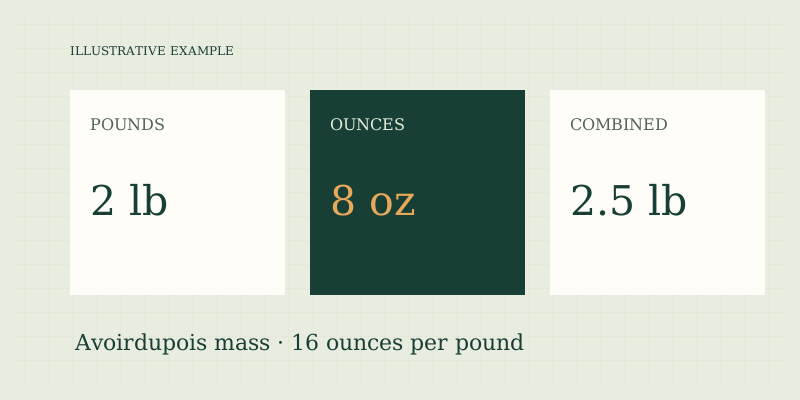
There are 16 avoirdupois ounces in a pound. An illustrative 2 pounds 8 ounces equals 2 + 8 ÷ 16 = 2.5 pounds. Multiplying 2.5 by 0.45359237 gives 1.133980925 kilograms. You could instead combine the input as 40 ounces and convert through the ounce factor. Do not enter 2.8 pounds when you mean 2 pounds 8 ounces. The decimal 0.8 pound is 12.8 ounces. The converter accepts a single decimal amount, so mixed units must be combined deliberately before entry. Retain the full combined decimal until the final report.
Convert metric prefixes carefully
A kilogram contains 1,000 grams. An illustrative 750 grams is 0.75 kilogram, not 7.5 or 0.075. Moving between prefixes changes the numerical value while preserving the physical quantity. Writing the units at every step helps prevent misplaced decimal points. The tool includes grams and kilograms, not every metric mass unit. If a specialized application uses milligrams or micrograms, do not repurpose another field without a carefully checked conversion. This site is not a medical-dosing tool. For health or safety applications, use the prescribed method and consult an appropriate professional.
Distinguish mass from force in context
Everyday language often uses weight for a reading expressed in pounds or kilograms. In technical work, mass and force are different quantities, and a pound-force is not the mass unit supported here. Read the specification rather than relying only on a familiar abbreviation. A shipping form, a laboratory method, or an engineering drawing may define gross mass, net mass, load, or force. The conversion tool does not determine which quantity you need. If you are subtracting packaging, obtain its actual mass. If you are calculating a structural load, use the appropriate technical method and qualified guidance.
Measurement quality still matters
Place a measuring instrument on a suitable surface, follow its instructions, and check that the displayed unit is the intended one. This guide does not certify any instrument or provide a calibration procedure. A unit conversion cannot correct a scale that was zeroed incorrectly or a source value copied from the wrong label. If the original reading is approximate, report the converted value as approximate. An illustrative reading of about 2.5 pounds might reasonably be described as about 1.13 kilograms for a rough comparison, while a regulated label may require a different method. Follow the actual standard for consequential reporting.
A mass-conversion checklist
- Read whether the source says pounds, ounces, fluid ounces, or a specialized unit.
- Confirm avoirdupois mass rather than troy mass or force.
- Combine pounds and ounces using 16 ounces per pound.
- Keep grams and kilograms separated by the correct factor of 1,000.
- Retain precision during arithmetic and round for the original measurement.
- Check whether net, gross, or another defined quantity is required.
- Use a density-based method only when converting a known material between mass and volume.
Try mass mode in the unit converter. Return to unit-conversion basics for compatible quantities. Read US liquid volume for fluid ounces and volume, mass, and density for recipe measurements.
Keep the tare separate
When a scale reading includes a container, the contents alone require subtracting the container's measured mass in compatible units. An illustrative 750 g gross reading with a 100 g container gives 650 g net contents. Those teaching quantities do not describe any product. Record whether the source is gross or net before comparing packages. Converting both numbers into kilograms does not fix a comparison that uses gross mass for one package and net mass for another.
FAQ
Is one ounce always 28.35 grams?
That rounded figure describes the avoirdupois mass ounce. A fluid ounce is a volume and a troy ounce is a different mass unit. Read the full label before converting.
Can I convert a cup of flour to grams here?
No. A cup measures volume, and flour mass depends on a relevant density or a measured recipe quantity. There is no universal cup-to-gram factor for all ingredients.
Can negative mass inputs be useful?
A signed value can represent a mathematical change, which the converter permits. An ordinary physical package mass should not be negative; investigate the measurement or input if it is.
Sources
- NIST: SI conversion factors, Appendix B.8 — mass conversion reference.
- Sources and methods — avoirdupois-only scope.
Put the method to work.
Open calculator ↗