
FIELD NOTES / Units & measures
Fahrenheit, Celsius, and kelvin: offsets matter
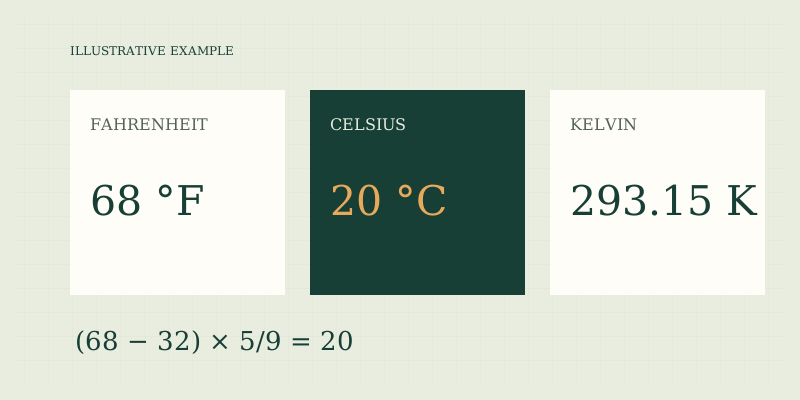
To convert a Fahrenheit reading to Celsius, subtract 32 and multiply by 5/9. To convert Celsius to Fahrenheit, multiply by 9/5 and add 32. Unlike a length conversion, temperature conversion cannot generally be performed with a multiplier alone because the scales use different zero points.
Convert the reading in the right order
For an illustrative 68 °F reading, first calculate 68 − 32 = 36. Then 36 × 5/9 = 20 °C. Reversing the operation gives 20 × 9/5 + 32 = 68 °F. The order of subtracting the offset and applying the scale is part of the formula.
| Illustrative reading | Formula | Equivalent reading |
|---|---|---|
| 32 °F | (32 − 32) × 5/9 | 0 °C |
| 68 °F | (68 − 32) × 5/9 | 20 °C |
| 20 °C | 20 × 9/5 + 32 | 68 °F |
| 20 °C | 20 + 273.15 | 293.15 K |
These are mathematical scale examples, not weather observations, equipment settings, or health recommendations. Context-specific decisions require more than a converted number.
Use kelvin with its correct notation
Kelvin readings relate to Celsius through K = °C + 273.15. The unit symbol is K without a degree sign. An illustrative 0 °C reading corresponds to 273.15 K. The numerical size of a one-kelvin interval matches that of a one-degree-Celsius interval, but their absolute readings have different zeros. The converter rejects readings below absolute zero under these scale relationships. A negative Celsius or Fahrenheit reading can be valid, while a negative kelvin reading is outside this tool's physical model. A rejected value may indicate that an offset was applied incorrectly or that a temperature difference was entered as an absolute reading.
Readings and differences use different rules
If an illustrative temperature rises from 20 °C to 30 °C, the difference is 10 Celsius degrees. Convert both endpoints to Fahrenheit: 68 °F and 86 °F. Their difference is 18 Fahrenheit degrees. For a temperature interval, multiply the Celsius difference by 9/5 without adding 32. This site's temperature mode converts absolute readings, not differences. Entering 10 °C returns 50 °F because it interprets 10 as a reading. It does not mean that a 10-degree-Celsius rise equals a 50-degree-Fahrenheit rise. Identify which kind of quantity your problem describes before choosing a method.
Avoid percentage comparisons on offset scales
A reading of 20 °C is not physically twice as hot as 10 °C merely because its number is twice as large. Changing to Fahrenheit changes that numerical ratio because the zero points differ. Percentage comparisons of temperatures require an appropriate physical context and scale. The general percentage calculator will perform arithmetic on entered numbers, but it cannot determine whether a ratio is meaningful for the quantity. Do not infer a physical relationship from a percentage of Celsius or Fahrenheit readings. For scientific or engineering use, follow the applicable method and consult a qualified specialist when needed.
Preserve measurement context
A converted temperature does not reveal where or how the reading was taken, whether an instrument is calibrated, or how long a process was maintained. A surface reading, air reading, and internal reading may describe different things even when expressed in the same unit. For cooking, equipment, medical, or safety questions, follow the relevant instructions and approved measurement method. This guide does not provide safe operating limits, food-safety thresholds, or medical interpretation. The tool is a scale converter, not a diagnostic or process-validation system.
Check precision and rounding
An instrument displaying whole degrees does not necessarily support a converted result with many decimal places. The tool shows up to ten significant digits for consistency, but you should report only precision appropriate to the original data and use. Keep the original unit available for verification. A small computational remainder near an expected exact value can come from finite-precision arithmetic. It does not justify adding a physical interpretation. For an important process, verify the conversion independently and follow the required rounding rule rather than relying on a generic display convention.
Temperature checklist
- Identify the input scale and whether the value is a reading or a difference.
- Apply the offset and scale in the correct order.
- Use K rather than a degree-marked kelvin symbol.
- Reject impossible absolute readings rather than hiding them.
- Keep measurement location, method, and precision with the result.
- Use a process-specific authority for consequential decisions.
Try temperature mode in the unit converter. Return to unit basics for dimensional checks, read length conversions to contrast pure scaling, and volume and density for another case where context affects a conversion.
FAQ
Why cannot I just multiply Fahrenheit by 5/9?
The Fahrenheit and Celsius zero points differ. For readings, subtract 32 before scaling. A temperature difference is a separate case that does not use the offset.
Is kelvin only Celsius with a different label?
No. The interval sizes match, but the reading has a different zero point. Add 273.15 to a Celsius reading to express it in kelvin.
Can this convert a medical or oven instruction?
It can convert a numerical reading between scales, but it does not validate the instruction, measurement method, or safety of a setting. Follow the relevant professional or manufacturer guidance.
Sources
- NIST: SI conversion factors, Appendix B.8 — temperature-scale conversion reference.
- Sources and methods — absolute-reading scope and precision.
Put the method to work.
Open calculator ↗