
FIELD NOTES / Dates & days
Calendar months are not fixed numbers of days
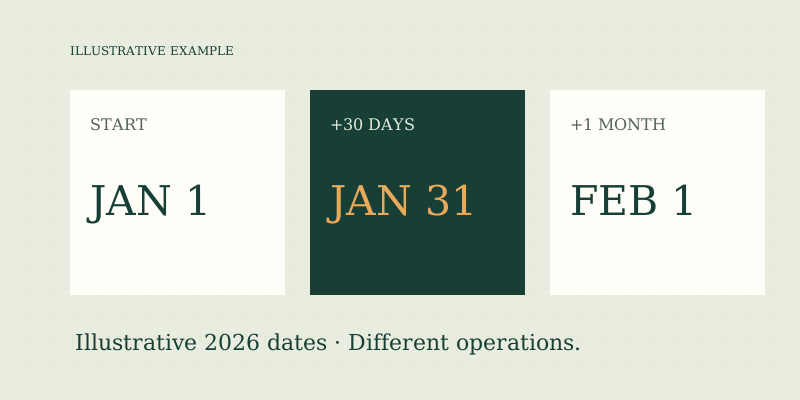
A calendar month is not a fixed number of days. Adding one month and adding 30 days can produce different dates, especially near month-end. Use a day offset when the instruction specifies days. For a month-based schedule, obtain an explicit rule for dates that do not exist in the target month.
Compare two different operations
An illustrative start of January 1, 2026 plus 30 days reaches January 31. One calendar month after January 1 is February 1 under a same-day-of-month rule. Those are different instructions, even though everyday speech sometimes treats a month as roughly 30 days.
| Illustrative instruction | Interpretation | What must be known |
|---|---|---|
| Add 30 days | Fixed day offset | Starting date |
| Add one calendar month | Move to a target month | Month-end policy |
| Count dates in February | Calendar enumeration | Year and leap status |
| Estimate months from days | Approximation | Chosen average and purpose |
Do not use an average-month conversion to establish a specific due date. An average can support a clearly labeled planning estimate, but it cannot identify the exact length of a particular month.
Month-end dates expose hidden rules
January 31 has no same-numbered date in February. A month-addition system might clamp the result to the last day of February, carry excess days into March, or reject the input. These are possible software policies, not a universal answer. A financial agreement or subscription may define a policy of its own. If you are implementing a recurring schedule, decide whether last day of each month is the actual intent. Starting with January 31 and repeatedly adding a month under a clamp policy may lose the month-end anchor unless the system preserves that intention. A recurring month-end schedule and repeated same-day-number additions are distinct algorithms.
Count actual days between month boundaries
To know how many days a particular calendar period contains, enter its actual start and end dates in the date calculator. An illustrative January 1 to February 1, 2026 interval spans 31 elapsed days. February 1 to March 1, 2026 spans 28; the corresponding interval in 2028 spans 29. If counting every date in a month, use the first and last dates with inclusive mode, or the first date of the next month with elapsed mode. These approaches agree when configured correctly. Mixing a next-month endpoint with an inclusive count adds an unwanted extra date.
Keep billing rules out of assumptions
A recurring monthly charge does not necessarily divide into a universal daily price. A provider may define prorating through actual days, a fixed divisor, calendar-month fractions, or another contractual rule. This site does not infer or endorse a billing method. Use the actual terms and ask the provider for clarification when needed. Similarly, a term stated in calendar months may have legal or administrative definitions. The day calculator can verify a specified interval after its endpoints are known, but it cannot determine what the agreement means. Consult the responsible organization or a qualified professional for consequential interpretations.
Years have the same kind of issue
A calendar year can contain 365 or 366 days. A fixed 365-day offset from a date is not always the same as moving to the same month/day in the next year. February 29 introduces an additional anniversary policy in common years. The leap-year guide discusses that boundary. A duration reported as 2.5 years may use an average, a contract-specific convention, or shorthand for two years and six months. Do not automatically translate it into days without identifying the intended definition. Units that sound familiar can still encode different rules.
A month-based scheduling checklist
- Copy the original instruction exactly: days, months, or years.
- Determine whether it describes a one-time offset or recurrence.
- Identify the target month before choosing a day within it.
- Obtain the policy for missing dates near month-end.
- Check whether a last-day-of-month anchor must be preserved.
- Keep holidays and cutoff-time adjustments as separate rules.
- Record any approximation used for rough planning.
Use the date calculator for actual day differences and fixed day offsets. Start with date-counting basics, then read inclusive days to avoid the extra endpoint and add or subtract days for forward checks.
Keep recurring and one-time rules distinct
A one-time day offset can be verified by reversing the same number of days. A recurring calendar schedule needs an anchor and a policy for every exceptional month. If you export such a schedule into a list of dates, check several consecutive months rather than only the first result. The first date can look reasonable while a later month drifts from the intended month-end pattern. Record the recurrence rule as well as the generated dates.
FAQ
Is one month always 30 days?
No. The exact length depends on the month and, for February, the year. Thirty days is a fixed duration that may be used as an approximation only when its limitations are stated.
Can this tool add calendar months?
No. Its offset mode accepts whole days. That avoids silently choosing a month-end policy that might conflict with your intended schedule.
How do I count one whole month exactly?
Identify the actual boundary dates and count between them. If the instruction itself is ambiguous about those boundaries, resolve that definition before calculating.
Sources
- US Naval Observatory: Leap Years — February leap-year dependency.
- Sources and methods — day-only scope and unsupported month policies.
Put the method to work.
Open calculator ↗