
FIELD NOTES / Dates & days
Weekdays are not always business days
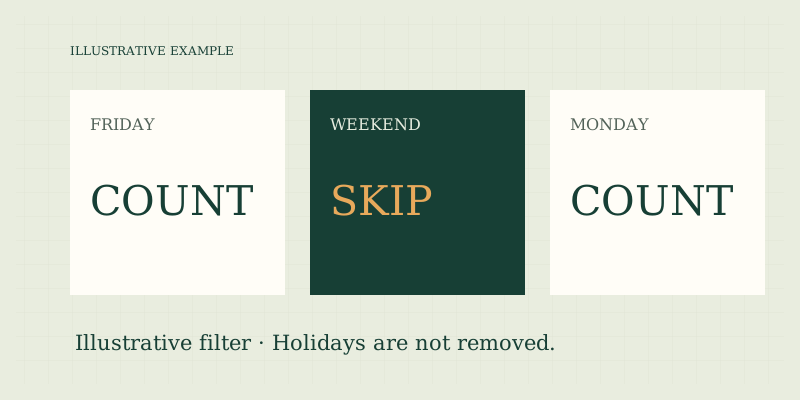
A weekday count usually means counting Monday through Friday. A business-day count depends on the organization, location, and applicable rule, and may exclude holidays or use another working week. This site's weekday mode removes Saturdays and Sundays only. It is not an authoritative business-day or legal-deadline calculator.
Understand the tool's filter
The calculator first applies your endpoint convention, then counts dates whose day of the week is Monday through Friday. It does not check whether an office, bank, school, or business is open. A Monday that an organization treats as a holiday still counts as a weekday here.
| Illustrative interval in January 2026 | Start excluded | Both dates included |
|---|---|---|
| Friday Jan 2 to Monday Jan 5 | 1 weekday | 2 weekdays |
| Saturday Jan 3 to Sunday Jan 4 | 0 weekdays | 0 weekdays |
| Monday Jan 5 to Friday Jan 9 | 4 weekdays | 5 weekdays |
These examples test the weekend filter and endpoint behavior. They do not describe an employer's schedule or an agency's opening dates. A five-day total may need further adjustments under a real business calendar.
Work a count manually
For Friday, January 2 through Monday, January 5 inclusive, list all four dates. Friday qualifies, Saturday and Sunday do not, and Monday qualifies. The result is two weekdays. With the start excluded, Friday is removed before filtering, leaving one qualifying date. For a long interval, each full seven-date block contains five Monday–Friday dates. Count complete weeks first, then inspect the remaining dates individually. This is the logic used in the calculator, which avoids looping through every date in a many-year interval. It still applies the same endpoint rules as a short manual list.
Gather the missing business-calendar information
If you need business days, identify whose calendar controls. A national holiday list may not match a state agency, a private company, a court, or an international counterparty. The word “business” in an agreement may be defined within that agreement rather than by ordinary usage. Also identify the location, time zone, and cutoff time. An event late in the day may be treated as received on a later date under a specific rule. A delivery service may have a selected service level and operating calendar. These are factual inputs that a generic Monday–Friday filter cannot safely infer.
Do not silently adjust deadlines
A deadline falling on a weekend may or may not move, and the direction and conditions depend on the applicable rule. Do not assume “next Monday” without checking. Some rules count calendar days but adjust only the final date; others count qualifying days throughout the interval. Those methods can produce different results. This guide gives no legal, tax, or filing advice. For an important deadline, use the actual notice, agreement, or official instructions and confirm with the responsible body. Seek a qualified professional if the rule is unclear or missing a deadline could have significant consequences. The calculator is useful for arithmetic checks after the governing convention is established.
Separate planning estimates from commitments
For a personal plan, a weekday count can help estimate available work sessions. Label it as a planning assumption, such as “ten Monday–Friday dates before holiday adjustments.” Then remove known absences, closures, or nonworking dates in your own schedule. A generic weekday total is a starting point, not a promise of productive days. When sharing the result, include the exact start, end, endpoint choice, and excluded days. “Five weekdays, start excluded, holidays not removed” is reproducible. “Five business days” may invite a different interpretation. A short assumptions note is often more valuable than an extra decimal place or a more elaborate calendar graphic.
A business-day verification checklist
- Identify the organization and rule that define a qualifying day.
- Confirm the triggering event and the date from which counting begins.
- Determine whether the start and end dates count.
- Obtain the relevant holiday and closure calendar.
- Check whether the rule adjusts only the final date or the full count.
- Verify cutoff times and the controlling time zone.
- Retain the official instruction used for the decision.
Use the date calculator to check Monday–Friday arithmetic. Return to date-counting basics for mode selection, inclusive days for endpoint examples, and date formats and time zones for copying dates across systems.
Keep exceptions as a separate list
For a personal plan, maintain a dated list of closures and absences instead of changing the calculator's weekday result without explanation. You can then show the unadjusted Monday–Friday total and each additional exclusion. Check that an exception is not already a Saturday or Sunday before subtracting it, or the same date could be removed twice. This manual planning worksheet still does not replace an official business calendar, but it makes your own estimate easier to audit.
FAQ
Does this calculator remove federal holidays?
No. It removes only Saturdays and Sundays in weekday mode. Holidays remain in the count regardless of whether an institution observes them.
Can I add ten business days with it?
No. Add/subtract mode moves by calendar days. Weekday mode counts qualifying dates in an already specified interval; it does not implement a holiday-adjusted forward scheduler.
Why did another tool give a different total?
Compare endpoints, weekend definitions, holiday calendars, and date formats. Different conventions can produce different correct answers to different questions. Check settings before assuming an arithmetic error.
Sources
- Sources and methods — exact weekday filter and unsupported holiday rules.
- US Naval Observatory: Leap Years — calendar convention underlying valid dates.
Put the method to work.
Open calculator ↗